
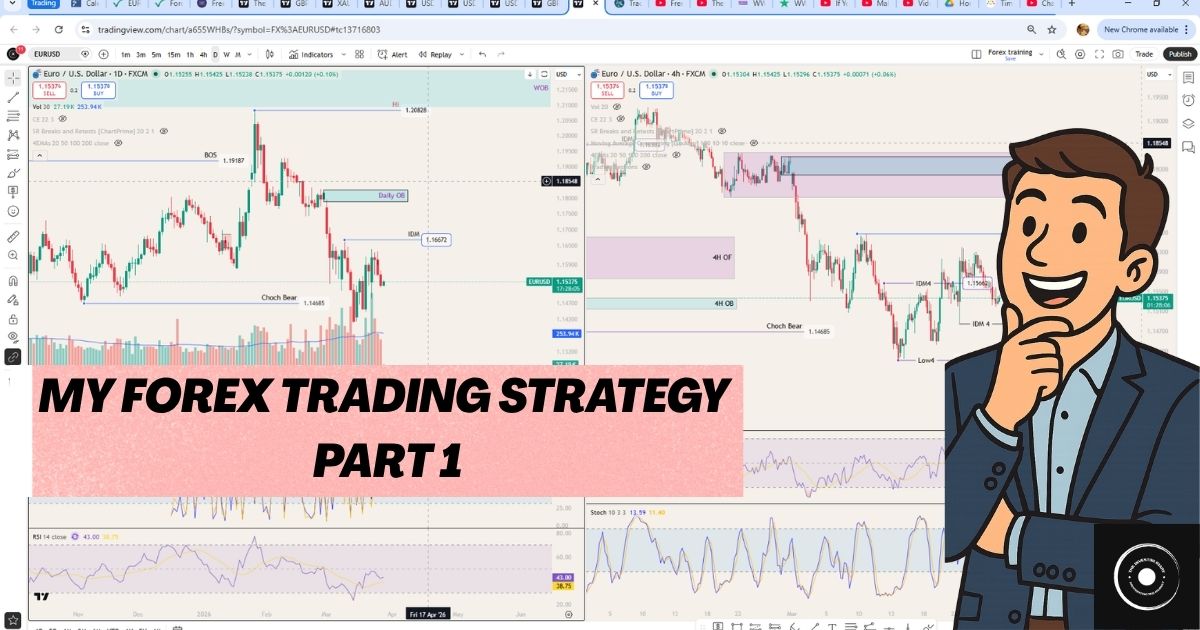
The Investor Diary Entry #114: March 27, 2026

In the past few weeks, I stepped away from content creation to focus entirely on testing and evaluating my trading plan. This process forced me to question what I was doing, what was working, and what was not. The result was not just a small adjustment, but a shift back to the foundation where everything originally started.
TL;DR
I paused content creation to test a trading plan, realized issues with stop-loss placement, and returned to market structure as the foundation. This marks the beginning of developing a Forex trading strategy that aligns with my broader system, including developing a Forex trading philosophy and defining each Forex trading strategic objective. The focus now is on improving execution before judging profitability.
Returning to the Foundation
During my testing phase, I explored different indicators and approaches. While they showed some potential, I struggled with one critical issue: defining a convincing stop-loss. I even tested trading without a stop-loss, which clearly did not work. When I did use stop-loss levels, they did not feel reliable or structured enough.
This led me back to market structure, which was the original foundation of my approach. What I realized is that clarity matters more than complexity. Market structure provides rules that feel more defined compared to the traditional classical school tools.
With the classical tools, there is always subjectivity. Different traders draw levels of support and resistance in different ways. The same applies to trend lines, where multiple valid interpretations can exist. In contrast, market structure offers clearer guidelines, such as identifying inducements and pullbacks within a trend.
This clarity is one of the main reasons I decided to return to it as the base for developing a Forex trading strategy.
Understanding Personal Preference in Trading
One important realization is that no method is inherently better than another. There are traders who succeed using classical support and resistance, just as there are traders who rely on market structure.
The difference comes down to personal style and how each trader processes information. In my case, I identify more with a hands-on approach. I need to test and experience concepts before fully understanding them. This plays a role not only in developing a Forex trading strategy but also in developing a Forex trading philosophy that reflects how I learn and make decisions.
This is why I see my work as a personal case study. The goal is not to present a universal solution, but to show how I am building my own trading environment.
The Structure of My Trading Platform
My trading platform is built on four elements: trading philosophy, strategic objectives, trading methodology, and the trading plan.
I have already worked on developing a Forex trading philosophy and defining each Forex trading strategic objective. Now, the focus shifts to the methodology, which is essentially the Forex trading strategy itself.
The strategy serves the objectives, and everything operates within the boundaries of the philosophy. This structure ensures that every decision is aligned and not random.
Execution Before Profitability
One of the key shifts in my thinking is understanding that profitability should not be the first focus. Before judging whether a plan works, I need to become proficient in executing it.
If I cannot apply a plan correctly, then any conclusion about its profitability will be misleading. The real question becomes whether the plan is flawed or whether my execution is the problem.
To remove this uncertainty, I need to train myself to execute the plan consistently. This means developing familiarity, building confidence, and reaching a level where applying the plan becomes natural.
Only then can I fairly evaluate its performance.
Defining the Core of My Strategy
As part of developing a Forex trading strategy, I made a few key decisions. I will focus on one currency pair, starting with EUR/USD, and limit my trading time to a maximum of three hours as per my trading philosophy.
The strategy will rely primarily on market structure tools. Indicators such as RSI or moving averages will still be present, but only as additional context. They will not be used as triggers for entering trades.
One area I recognize as a weakness is reading price action, particularly candle formations. Identifying reactions in the market requires interpreting price behavior, which I currently find less comfortable. This is something I will need to improve as I continue refining my strategy.
Introducing Premium and Discount
One of the strategies that I mention in detail in the above Youtube video, is that I will only buy at Fibonacci discount, and sell at Premium.
Using a defined range, the 50 percent level acts as a divider. Anything above this level is considered premium, and anything below is considered discount.
For selling opportunities, I will only look in the premium zone. For buying opportunities, I will focus on the discount zone. This rule adds structure and filters out trades that do not align with the overall logic of the strategy.
This is only the first part of the methodology, and it sets the foundation for the next steps.
FAQ
What is the main focus of this phase?
The focus is on developing a Forex trading strategy that aligns with the overall trading platform and improving execution before evaluating results.
Why return to market structure?
Market structure provides clearer rules compared to other methods, making it easier to apply consistently.
Are indicators completely removed?
No, they are still used, but only as supporting tools rather than decision-making triggers.
Why is execution more important than profitability at this stage?
Without proper execution, it is impossible to determine whether a strategy truly works.
What does premium and discount mean in this context?
It refers to dividing a trading range at the 50 percent level, using the Fibonacci retracement tool, to identify better areas for buying or selling.
Conclusion
This is the starting point of refining my approach to trading. By returning to market structure and focusing on execution, I am laying the groundwork for a more structured and consistent process.
This journey is not about finding a perfect system immediately, but about building one step by step, ensuring that each part supports the next.
The Investor
Friday 27 March 2026
About The Author
I started to look into individual stocks in January 2022. I created this diary initially for myself to track my investing progress, and second, as a place where I can share my ideas publicly, not only on stock investment, but on any venture that I start learning, such as Forex Trading, Blogging, or any other future venture that I might think of trying out.
By repeating things to myself, I learn by trying to explain them to others; therefore, I help myself better understand what I am learning. Additionally, hoping that others will share their ideas and learn from each other, and lastly as an online business where some links that I share are affiliate links, and if anybody bought anything by clicking those links, I will get a commission based on that successful sale, which of course will not affect the price at which you are buying the product or service.
For more detailed information on my affiliate disclosure, please refer to the Full Affiliate Disclosure page.
This blog is also part of my blogging learning project. I’m using a platform to learn this part. If you are interested in it, it is called Wealthy Affiliate.
Furthermore, this site is in no way or form giving any financial or investing advice, nor is it encouraging or discouraging people to buy or sell any financial instrument. This is a personal diary in which I track my own progress and share it for informational, educational, and entertainment purposes.