
The Investor Diary Entry #117: April 1, 2026
The decision to start trading Forex brings plenty of excitement to the extent that beginners tend to ignore some important aspects of the journey. When jumpstarting the Forex adventure, two terms one runs into a lot, and many tend to skip, as they play the part of party poopers to the initial excitement. These two terms are: leverage and margin.
These two terms normally go together and can make a huge difference in your trading outcomes. They come with risks as well, so it’s crucial to get a clear understanding of how they work if you want to safeguard your funds and make smarter moves. In this article, I’m going to break down what leverage and margin actually mean, how they operate in Forex, and hand out practical tips for using them wisely.
TL;DR: Leverage and Margin in Forex Trading for Beginners
Leverage lets you control a much larger trade size with only a modest amount of your own capital—this required chunk is called margin. While leverage can boost both profits and losses, understanding how it works and managing your margin closely is super important for anyone new to Forex trading. The key is to keep your risk under control.
Understanding Leverage and Margin in Forex Trading
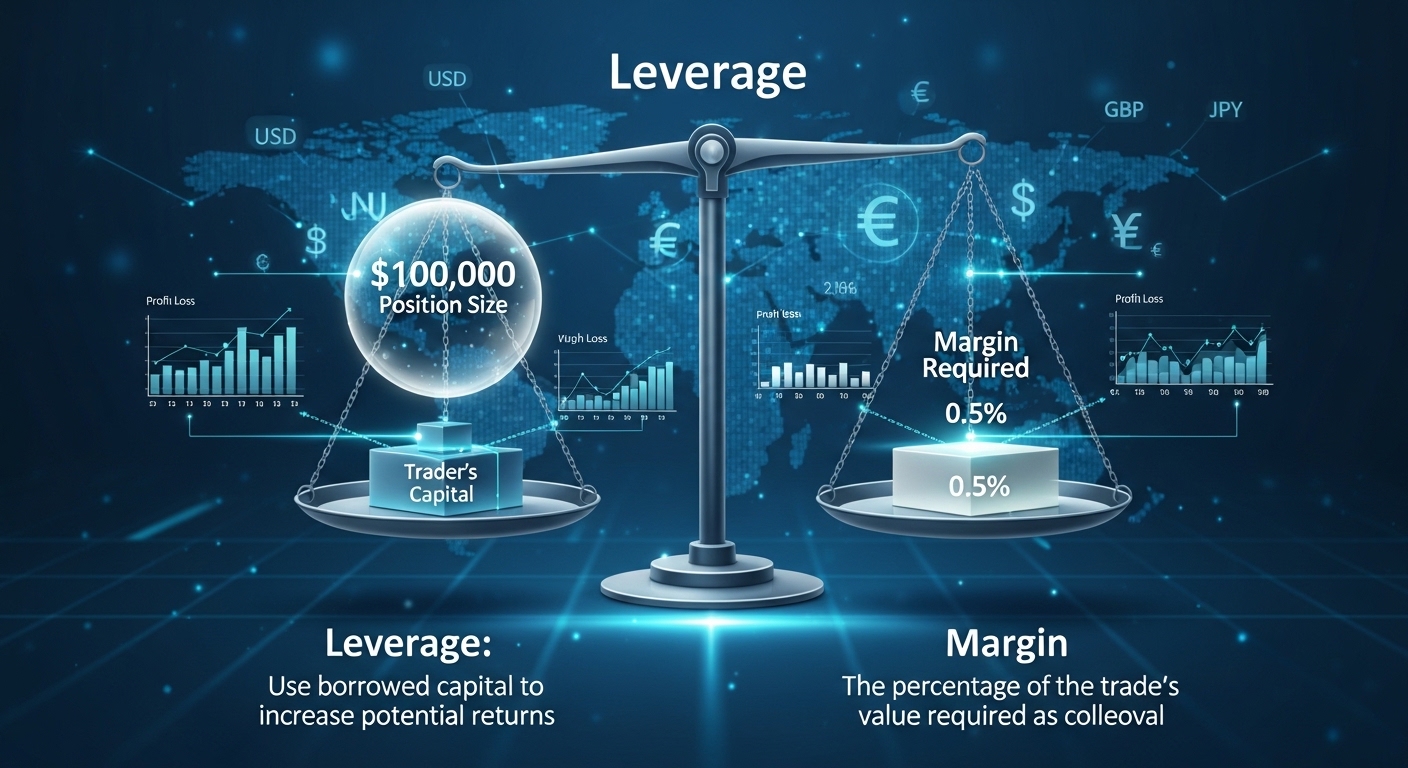
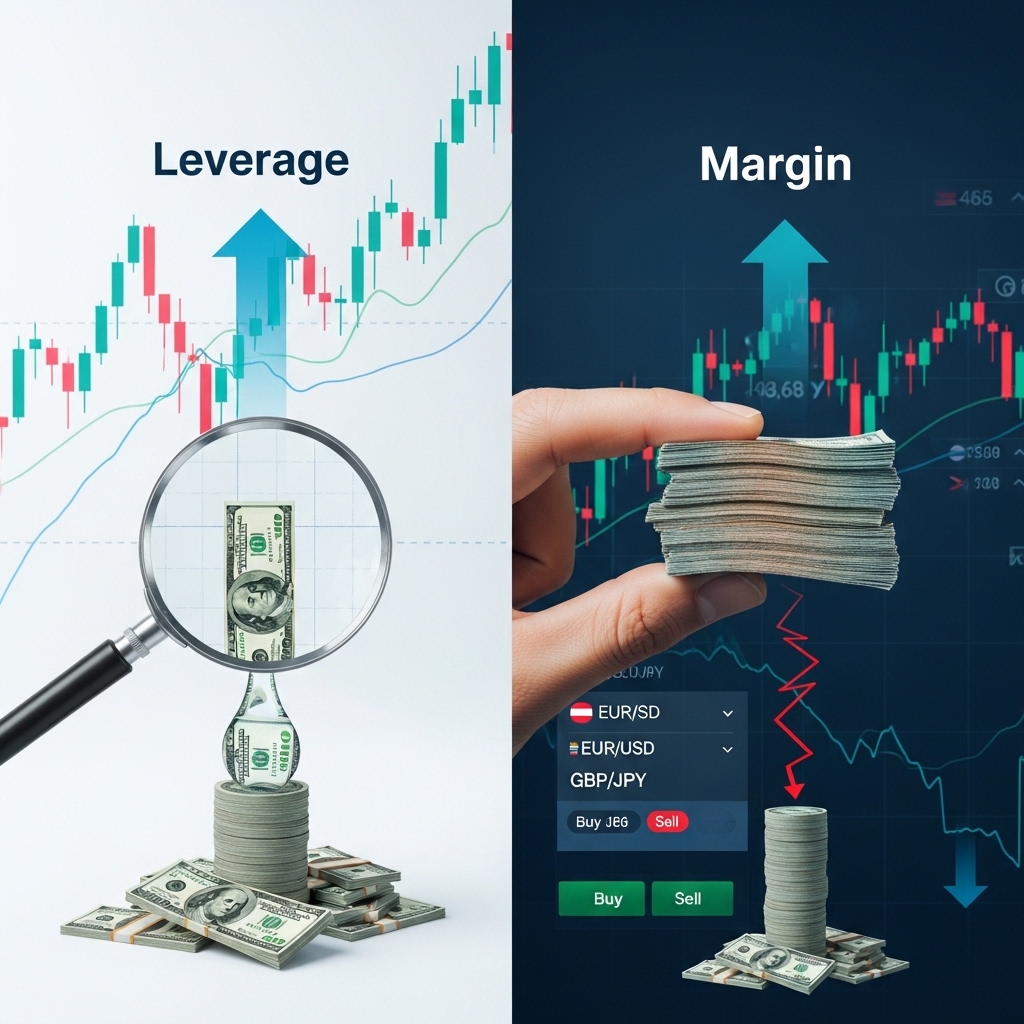
Leverage and margin are often mentioned together, yet they’re not the same. Leverage means being able to control a bigger position with less cash. Margin is the actual amount you’re required to stash in your account to open and hold that larger trade. Trading with margin involves borrowed funds from your broker, so instead of putting up the total trade value, you only commit a small piece as collateral.
If you are just starting with Forex trading, grasping how leverage and margin work in tandem is a major step toward avoiding surprising losses and trading with confidence.
Forex Trading Leverage: What It Is and How It Works
In Forex, leverage is typically written as a ratio—such as 50:1 or 100:1. This ratio shows how much larger your trades can be relative to your real account balance. For instance, a 100:1 leverage ratio means you get to control $100,000 with just $1,000 of your funds.
- How brokerage leverage works: When you start a position with leverage, your broker loans you extra cash to grow your buying or selling power. You only cover a slice of the overall trade size (the margin).
- Margin requirement example: Want to trade a standard lot of 100,000 units, and your broker asks for a 1% margin? You put down $1,000, and leverage takes care of the rest.
- Leverage boosts both profit and risk: If things go your way, your profit multiplies. If not, losses pile up just as quickly.
Leverage is really useful when handled with care, but it’s also why many traders lose money fast. Because of this, many countries now set limits on how much leverage brokers can offer to retail traders, trying to protect folks from heavy losses. Checking your broker’s leverage policy first is a smart move.
How Margin Fits Into Forex Trading
Margin is the real money you need to earmark to open a leveraged trade. Think of it as a security deposit showing you’re serious. It isn’t a fee—you get your margin back if the trade closes out in profit or you exit before severe losses.
- Initial margin: This is what you need to kick off a new trade. For a 1% margin on a $10,000 trade, your initial margin sits at $100.
- Maintenance margin: Brokers want you to keep a certain balance in your account to support your leveraged trades. If you dip beneath this level, you’ll get a margin call (a request to add more cash to your account).
Trading on margin lets you take bigger positions, but keep in mind you’re risking more than your balance implies. If the market makes a small swing against you, your margin can evaporate in no time.
Leverage, Margin, and Risk: The Tight Connection
Leverage and margin bring bigger chances, but also higher risks. When the market turns the wrong way, losses multiply fast. If things spiral badly, your account balance can drop to zero, or in rare situations, even dip below that.
- Margin call: If your equity drops below the required maintenance margin, a margin call lands. Your broker will ask for more money or start closing trades to protect both parties from deeper losses.
- Stop-out level: Ignoring the margin call leads to the broker stepping in and shutting down your trades once your equity hits a set stop-out level.
Smart risk management is crucial when you’re using leverage. Even if you believe in your trade, running with lower leverage and keeping plenty of margin is always the safer route. High leverage might sound tempting, but it can come back to bite you if markets move fast.
Getting Started: Essential Forex Trading Terms and Examples
If you are new, it’s a good idea to check out some Forex trading basics and lingo. Here are a few terms to help when working with leverage and margin:
- Lot: Standard size for Forex trades. 1 lot equals 100,000 units, while mini, micro, and nano lots cover smaller sizes.
- Pip: Stands for “percentage in point”—the smallest price movement a currency pair can make (typically 0.0001).
- Margin level: Calculated by dividing account equity by used margin, this percentage tells you how much extra security you have. When it sinks too low, brokers intervene.
- Free margin: Refers to the part of your equity that’s not tied up in active trades. This is what you can use for opening new positions.
Quick example: Say you have $2,000 in your trading account and plan to open a $40,000 position. With 20:1 leverage, your margin requirement is $2,000 (5%). If things move 100 pips in your favor, your profits multiply. When the market swings against you that same amount, losses are pulled straight from your margin.
Practical Tips for Using Leverage and Margin Responsibly
- Start small: Just because brokers offer big leverage doesn’t mean you have to use it all. Lower leverage provides more wiggle room and helps to keep losses under control.
- Monitor margin level: Always check your margin level percentage, especially when there’s a lot of volatility. If it drops, you’re heading toward a margin call.
- Set stop-loss orders: Stop-losses can help limit potential losses and could save your account from massive swings.
- Understand position size: Figure out how much you’re willing to lose on a single trade. Pick your lot size and leverage based on your personal risk tolerance.
- Don’t risk it all: Never risk your entire balance in one go—since leverage amplifies mistakes as much as it boosts winnings.
Common Questions About Leverage and Margin in Forex
Question: How much leverage should beginners use?
Answer: Beginners are safer sticking to low leverage like 10:1 or even 5:1. This gives you time to learn without a lot of stress. Increase leverage only when you’re sure of your grasp of building a Forex trading game plan and risk management.
Question: Can I lose more than my deposited margin in Forex trading?
Answer: Most brokers offer negative balance protection, so you shouldn’t lose more than your deposit. Yet, during crazy market conditions, it’s possible to take a bigger hit, so you should always ask your broker about their policy first.
Question: What’s the best way to avoid margin calls?
Answer: Maintain enough free margin, use stop-loss orders, and don’t max out your leverage on a couple of trades. Smart habits and sticking to Forex trading strategies will help keep margin calls rare.
Question: Why do brokers offer high leverage?
Answer: High leverage is a big draw for new clients and pumps up market activity. Just because it’s available doesn’t mean it’s the best move for a beginner. Use it with care and pick risk levels that match your knowledge.
Final Thoughts on Leverage and Margin in Forex Trading
Leverage and margin are core to Forex trading, giving you access to bigger trades with less money upfront. While this is definitely eye-catching, smart trading asks for careful use of leverage and a constant eye on risk. If you’re just starting out, stick to lower leverage, learn the basics, and fine-tune your strategies before taking bigger risks. The better you understand margin, leverage, and how they mix, the more ready you’ll be to grow your trading skills—and protect your account at the same time.
The Investor
Wednesday 1 April 2026
About The Author
I started to look into individual stocks in January 2022. I created this diary initially for myself to track my investing progress, and second, as a place where I can share my ideas publicly, not only on stock investment, but on any venture that I start learning, such as Forex Trading, Blogging, or any other future venture that I might think of trying out.
By repeating things to myself, I learn by trying to explain them to others; therefore, I help myself better understand what I am learning. Additionally, hoping that others will share their ideas and learn from each other, and lastly as an online business where some links that I share are affiliate links, and if anybody bought anything by clicking those links, I will get a commission based on that successful sale, which of course will not affect the price at which you are buying the product or service.
For more detailed information on my affiliate disclosure, please refer to the Full Affiliate Disclosure page.
This blog is also part of my blogging learning project. I’m using a platform to learn this part. If you are interested in it, it is called Wealthy Affiliate.
Furthermore, this site is in no way or form giving any financial or investing advice, nor is it encouraging or discouraging people to buy or sell any financial instrument. This is a personal diary in which I track my own progress and share it for informational, educational, and entertainment purposes.