
The Investor Diary Entry #105: January 4, 2026
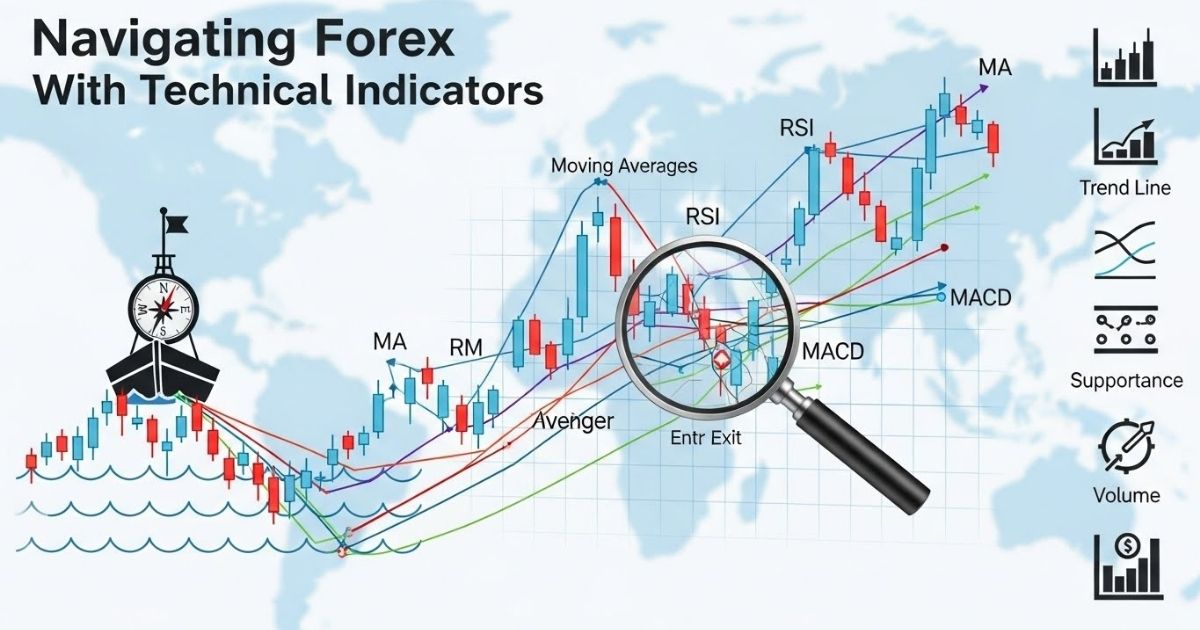
Navigating Forex with technical indicators often feels straightforward on the surface, yet difficult in practice. Many traders use indicators daily, but few pause to reflect on what those indicators truly represent. This article continues an ongoing exploration into developing a trading philosophy by focusing on cause and effect in Forex trading, using technical indicators as the observed effect of price rather than the driver behind it.
TL;DR
Technical indicators are a reflection of price, not a force that moves it. This article walks through an experiment using daily, weekly, and four-hour indicators to understand how indicators behave over time, how results can be misleading in the short term, and why patience and philosophy matter when navigating Forex with technical indicators.
Understanding Cause and Effect in Forex Trading
At the core of this discussion is a simple idea: indicators are the effect, not the cause. Technical indicators do not move the market. They repackage what price has already done. This distinction becomes critical when navigating Forex with technical indicators, especially when traders expect indicators to generate consistent results on their own.
The experiment discussed here was part of a broader attempt at developing a trading philosophy. It focused on understanding how indicators behave across different timeframes without assigning them predictive power beyond what price itself provides.
The Experiment Setup and Timeframes Used
The study examined multiple currency pairs, including EURUSD, GBPUSD, USDJPY, USDCHF, and USDCAD in detail, with AUDUSD and NZDUSD included at a higher level. The charts were reviewed once per day at a fixed time, using weekly, daily, and four-hour timeframes.
The daily setup relied on stochastic levels combined with RSI conditions. Trades were only considered when multiple conditions aligned, and some indicators were used strictly for informational purposes rather than as part of the core playbook. The four-hour timeframe was used to align entries within a specific viewing window, reinforcing discipline and consistency.
Price Action in Trading Forex Versus Indicator Output
One of the most revealing aspects of the experiment was how price action in trading Forex unfolded independently of indicator signals. Over the first six months, the results were effectively flat. Despite numerous trades, wins and losses canceled each other out, leaving the account balance nearly unchanged.
This period was psychologically challenging, as it created the feeling that effort was producing no result. However, this phase highlighted an important reality: indicators can remain active while price goes nowhere meaningful. The real movement only appeared later in the year, reinforcing the idea that time and market context matter more than constant activity.
Daily Versus Weekly Indicator Performance
When comparing timeframes, the difference between daily and weekly indicators was striking. The daily approach produced a modest annual return, while the weekly approach delivered a significantly higher result with far fewer decisions involved.
The weekly method relied almost entirely on stochastic behavior, without additional filters. This raised important questions related to developing a trading philosophy, particularly around simplicity, patience, and the role of long-term positioning versus frequent decision-making.
The results echoed a broader investment principle: holding positions based on higher timeframes often outperforms attempts to time every move. Navigating Forex with technical indicators becomes less about precision and more about alignment with broader price behavior.
Win-Loss Ratio, Risk, and Trade Management
The experiment also challenged common assumptions about win-loss ratios and stop-loss placement. Despite having more losing trades than winning ones on the daily timeframe, the overall performance remained positive. This suggested that trade duration and exit logic mattered more than the number of wins.
Exits were determined by indicator behavior rather than fixed stop-loss levels. This approach emphasized structure over mechanical risk formulas and reinforced the idea that indicators reflect ongoing price conditions rather than predefined outcomes.
Lessons for Developing a Trading Philosophy
The most important takeaway was not the percentage return, but the insight gained. Navigating Forex with technical indicators requires acceptance of uncertainty, long periods of stagnation, and emotional discomfort. The experiment showed that relying on indicators alone can work, but it also exposes traders to extended drawdowns and delayed results.
This reinforces the need for a personal framework. Developing a trading philosophy means understanding what you are willing to endure, how often you want to engage with the market, and how you interpret price action in trading Forex over time.
Frequently Asked Questions
Do technical indicators move the market
No. Indicators are a representation of price behavior. They do not influence price movement.
Why did the strategy show no results for months
In my point of view, because price remained within ranges where indicator signals canceled each other out, resulting in no net progress.
Is a higher win rate necessary to succeed
No. The experiment showed that profitability can occur even with more losses than wins. Still, the methodology needs to generate enough wins to compensate for the losses.
Why did weekly indicators perform better
They reduced noise and aligned more closely with longer-term price movements.
Can indicators be used without price context
I think they can, but understanding the price context will give better results.
Conclusion
Navigating Forex with technical indicators is less about finding the perfect setup and more about understanding what indicators truly represent. This experiment demonstrated that indicators are tools for observation, not control. For those asking how to become a successful Forex trader, the answer may lie not in adding more indicators, but in building patience, perspective, and a trading philosophy rooted in cause and effect.
The Investor
Sunday 4 January 2026
About The Author
I started to look into individual stocks in January 2022. I created this diary initially for myself to track my investing progress, and second, as a place where I can share my ideas publicly, not only on stock investment, but on any venture that I start learning, such as Forex Trading, Blogging, or any other future venture that I might think of trying out.
By repeating things to myself, I learn by trying to explain them to others; therefore, I help myself better understand what I am learning. Additionally, hoping that others will share their ideas and learn from each other, and lastly as an online business where some links that I share are affiliate links, and if anybody bought anything by clicking those links, I will get a commission based on that successful sale, which of course will not affect the price at which you are buying the product or service.
For more detailed information on my affiliate disclosure, please refer to the Full Affiliate Disclosure page.
This blog is also part of my blogging learning project. I’m using a platform to learn this part. If you are interested in it, it is called Wealthy Affiliate.
Furthermore, this site is in no way or form giving any financial or investing advice, nor is it encouraging or discouraging people to buy or sell any financial instrument. This is a personal diary in which I track my own progress and share it for informational, educational, and entertainment purposes.