
The Investor Diary Entry #108: February 17, 2026
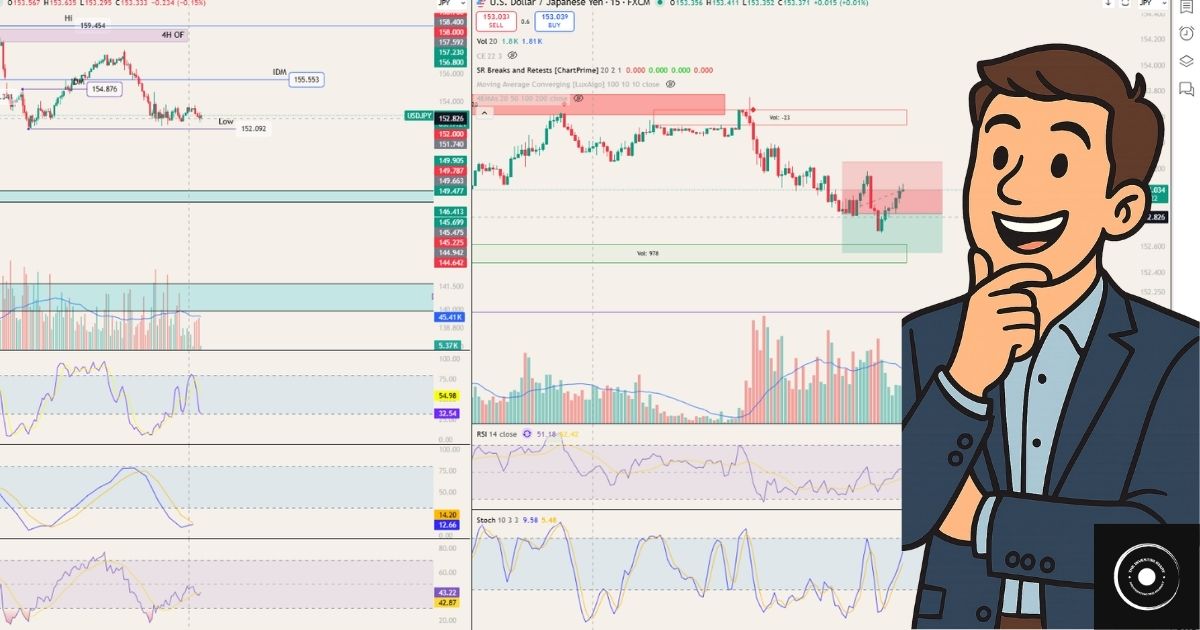
In this trading session, I reviewed a USDJPY short position through the lens of my personal trading platform. This platform is built around four core components: trading philosophy, strategic objectives, methodology, and a detailed trading plan. The focus here is on whether the execution of this trade respected the philosophy and selling conditions defined in advance. The idea is simple: apply Forex market structure analysis consistently and evaluate whether discipline aligns with results.
TL;DR
This USDJPY short trade was taken based on daily and 4-hour market structure, RSI confirmation, stochastic positioning, chandelier exit signals, and support and resistance analysis. Most conditions aligned with the solid Forex trading plan, except for the 15-minute stochastic trigger, which was entered too deep below the defined level. The trade highlights the importance of following rules precisely to avoid unnecessary emotional pressure.
Pre-Trade Preparation and News Awareness
Before entering any position, I check the economic calendar. On this day, I avoided GBP and CAD pairs due to scheduled news events. At the time of execution, those releases had not yet occurred. This filtering process is part of risk management and time allocation. The trade was placed on a Tuesday, respecting the rule to avoid trading on Fridays.
Trading time was limited to one and a half hours, staying within the maximum three-hour window defined in the philosophy. There was no stop-loss used, in line with the ongoing testing phase of the platform, with the condition of daily monitoring.
Daily and 4-Hour Market Structure Analysis
On the daily timeframe, price moved below inducement levels, grabbing liquidity before showing signs of reaction. The Fibonacci retracement did not reach deeper levels such as the 0.618 area, which suggested potential continuation toward a daily order block. This aligns with the expectation that price may seek deeper liquidity.
On the 4-hour timeframe, the broader structure showed an opposite direction to that of the Daily, but aligning with the theory that the daily is still going down to grab more liquidity. This structure is moving downward with a previous break of structure to the downside. It went up, grabbing liquidity and reacting from an order block. The short position targeted approximately 30 pips, consistent with the trading plan.
This multi-timeframe Forex market structure analysis provided the directional bias. The daily supported a corrective move downward, while the 4-hour offered the execution framework.
RSI and Stochastic Confirmation
The RSI on both the daily and 4-hour timeframes was below 50 and below their respective moving averages. This satisfied the selling condition. Momentum favored the downside, reinforcing the bias established through structure.
The stochastic on the daily was below 32, placing it in the selling zone. Although the K line flipped above the D line, it remained under 32, which still qualifies as a selling area within the plan. However, this flip was noted as a potential concern.
On the 4-hour timeframe, stochastic showed clear downward movement with space between K and D. It had not yet reached the 32 level, leaving room for continuation.
The issue appeared on the 15-minute timeframe. According to the plan, the stochastic should just be crossing down toward 32. Instead, it was deeply below, with values around 10 and 15. This violated the trigger condition. Despite other confirmations being favorable, entering at that depth increased emotional pressure when price temporarily moved against the position.
This experience reinforces how precision matters in how to become a successful Forex trader. Small deviations from rules can create disproportionate psychological stress.
Chandelier Exit and Moving Averages
The chandelier exit indicator signaled a sell on the daily, 4-hour, and 15-minute charts. This added confluence.
Exponential moving averages on the daily chart were mostly above price, except for the 200 EMA, which was below but also below a key support level. On the 15-minute and 4-hour charts, all major EMAs were above price, and on the 4-hour, the 50 EMA was crossing below the 200 EMA, supporting bearish momentum.
These technical confirmations strengthened the case for the short position.
Support, Resistance, and Take Profit Logic
On the 15-minute chart, support was identified near 152.61, while the entry was around 152.85. The 30-pip minimum requirement was respected. Although the support was relatively close, it was considered somewhat transparent, meaning price could penetrate it before reacting.
On the 4-hour chart, resistance levels were visible, and a potential retest could pose a threat to the trade. However, no immediate nearby support invalidated the entry.
The daily return target was defined before execution, consistent with the solid Forex trading plan. The philosophy emphasizes no losing trades and no stop-loss, both controversial ideas that require strict monitoring and discipline.
Risk Concentration and Pair Selection
Although other JPY pairs showed similar setups, only one trade was taken. Multiple positions based on the same theory increase correlated risk. If the theory fails, all related trades could fail together. Avoiding overexposure is part of structured decision-making.
FAQ
Why was the 15-minute stochastic entry considered a mistake?
Because the plan requires the stochastic to just cross toward 32. Entering when it was already deeply below increased the chance of a short-term reversal and emotional stress.
Why avoid trading GBP and CAD on that day?
Scheduled news events introduce volatility and unpredictability. The decision was to stay out of those pairs to maintain controlled conditions.
Why use multiple timeframes in Forex market structure analysis?
The daily provides context, the 4-hour refines direction, and the 15-minute offers entry precision. Alignment increases probability.
Is trading without a stop-loss advisable?
It is part of a tested philosophy within this platform, combined with daily monitoring. It remains controversial and requires discipline.
Conclusion
This USDJPY short position largely respected the predefined structure, RSI, stochastic, and confirmation rules. The only deviation was the early stochastic trigger on the 15-minute timeframe. That single adjustment could have reduced emotional turbulence.
Consistency in applying rules is central to how to become a successful Forex trader. A solid Forex trading plan is not just about identifying opportunities but about executing them precisely as designed. Discipline, structured analysis, and controlled exposure remain the foundation of sustainable performance.

The Investor
Tuesday 17 February 2026
About The Author
I started to look into individual stocks in January 2022. I created this diary initially for myself to track my investing progress, and second, as a place where I can share my ideas publicly, not only on stock investment, but on any venture that I start learning, such as Forex Trading, Blogging, or any other future venture that I might think of trying out.
By repeating things to myself, I learn by trying to explain them to others; therefore, I help myself better understand what I am learning. Additionally, hoping that others will share their ideas and learn from each other, and lastly as an online business where some links that I share are affiliate links, and if anybody bought anything by clicking those links, I will get a commission based on that successful sale, which of course will not affect the price at which you are buying the product or service.
For more detailed information on my affiliate disclosure, please refer to the Full Affiliate Disclosure page.
This blog is also part of my blogging learning project. I’m using a platform to learn this part. If you are interested in it, it is called Wealthy Affiliate.
Furthermore, this site is in no way or form giving any financial or investing advice, nor is it encouraging or discouraging people to buy or sell any financial instrument. This is a personal diary in which I track my own progress and share it for informational, educational, and entertainment purposes.