

The Investor Diary Entry #135: May 6, 2026
Calculating profits and losses in Forex trading can feel like a tough code to crack, especially if you’re just getting started. The good news is, once you break down the basics, things get a lot simpler pretty quickly. I’m going to walk you through clear methods for finding out whether your Forex trades put extra cash in your pocket or took some out. By the end, you’ll have a reliable, easy-to-follow process for tracking your results and making smarter trading choices.
TL;DR: Quick Overview on Calculating Profits and Losses in Forex
To calculate profit or loss in Forex trading, find the difference between your open and close prices, multiply that by your lot size, and adjust for the specific pair’s pip value. Whether trading major pairs or exotics, understanding how leverage, margin, and risk management factor in is really important for both protecting your account and maximizing gains. Getting comfortable with these calculations gives you the confidence to plan ahead and avoid surprises.
Understanding the Basics of Calculating Forex Profits and Losses
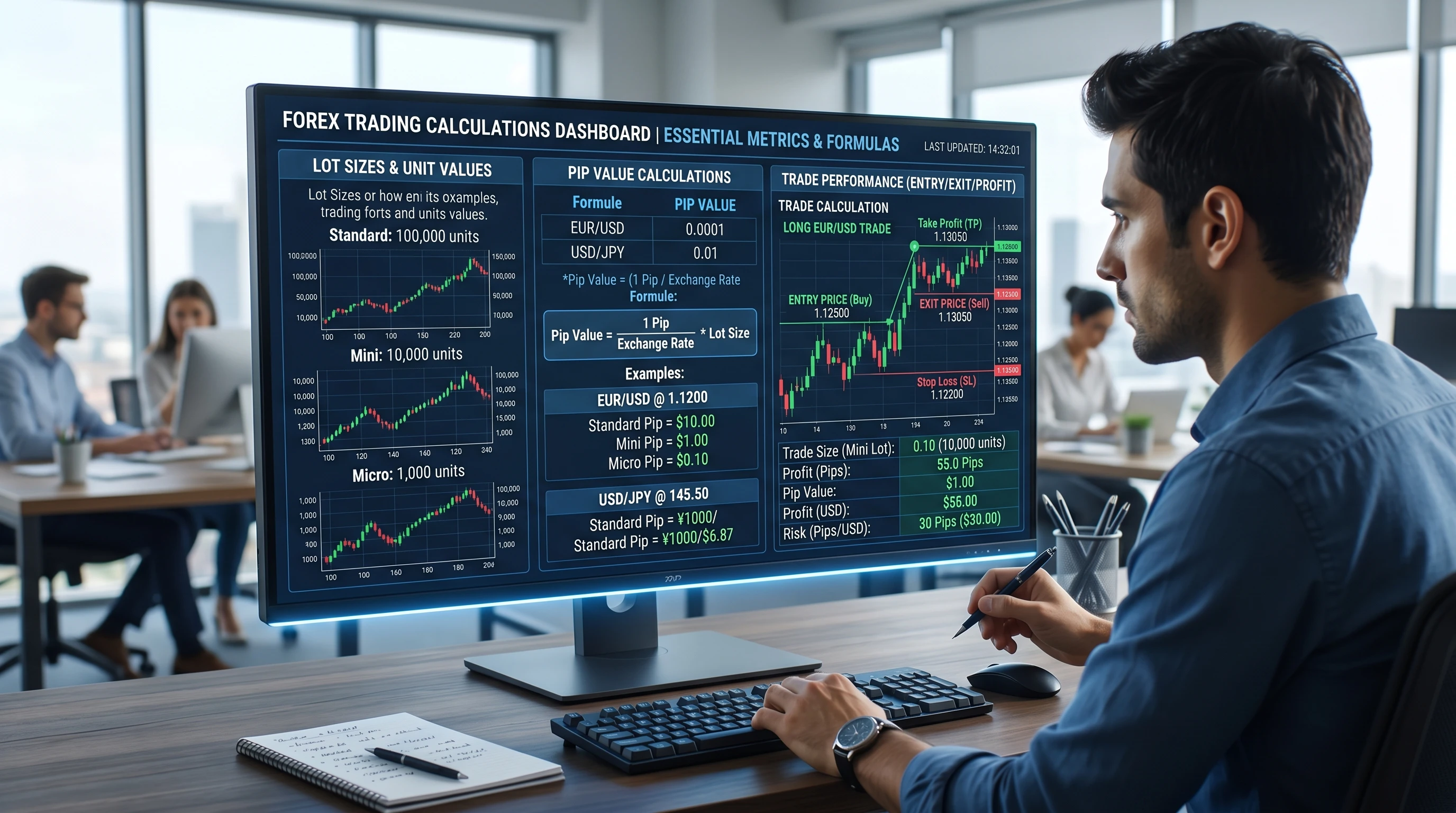
Calculating profits and losses in Forex trading is mainly about knowing three things: the size of your trade (or lot), what a pip is worth, and how far the price moved in your favor (or against you). Here’s a simple rundown:
- Lot Size: This is how much currency you’re buying or selling. A standard lot is 100,000 units, a minilot is 10,000, and a microlot is 1,000.
- Pip: A pip is the smallest price movement for a currency pair (usually the fourth decimal place, or second for yen pairs).
- Pip Value: The amount you gain or lose for every pip that moves, depending on your lot size and the currency pair you’re trading.
If you’re trading EUR/USD and you buy (go long) at 1.1000 and sell at 1.1050, that’s a 50-pip gain. Trading one standard lot (100,000 units), each pip is worth $10, so your profit is 50 x $10 = $500.
Step-by-Step: Calculating Profit and Loss in Forex Trading
So, how do you actually put this all together without scratching your head too much? Here’s a step-by-step guide I lean on whenever I track a trade:
- Note Your Entry and Exit Prices. Write down the price where you opened the trade and the price where you closed.
- Calculate Pip Difference. Subtract entry from exit (or vice versa for a sell) to find how many pips the price moved.
- Multiply by Pip Value. Use the correct pip value for your lot size and currency pair. For most USD-based pairs, that’s $10 for a standard lot, $1 for a mini, and $0.10 for a micro.
A quick formula you might find pretty handy looks like this:
Profit/Loss = (Exit Price – Entry Price) x Lot Size x Pip Value
For a sell, just flip the entry and exit calculation.
Major Factors to Watch: Leverage, Margin, and Risk Management
The numbers on their own don’t tell the whole story. Leverage and margin play a big part in how much you stand to gain, or lose. Leverage lets you control large positions with less money, but it also bumps up your risks. Margin is the amount you need in your account to keep your trades open.
You can check out a full breakdown of leverage and margin to see how these impact your results.
Good trading is really about solid risk management practices. Never risk more than you’re comfortable losing, and always know your exit before opening a trade. Calculating profits and losses in Forex trading helps you set realistic goals and stay on track.
Common Calculation Examples (With Real Numbers)
Example 1: You trade one standard lot of USD/JPY. You go long at 145.00 and close the trade at 145.50. That’s 50 pips profit. Each pip in a standard USD/JPY lot is worth 1,000 yen. If the current USD/JPY rate is 145.00, each pip is about $6.90 (since 1 pip = 1,000 ÷ 145 = $6.90). So, 50 x $6.90 = $345 profit.
Example 2: You short EUR/USD with a minilot (10,000 units) from 1.0700 and cover at 1.0680. That’s 20 pips, each worth $1 for a minilot, so the profit is $20.
How to Use Tools and Calculators for Easy Forex Profit and Loss Tracking
Most brokers have built-in calculators to help with calculating profits and losses in Forex trading. Plug in your lot size, entry/exit prices, and currency pair, and they’ll spit out your results instantly. Mobile trading apps and spreadsheets are super useful for doublechecking your numbers or tracking your daily and weekly results for patterns.
If you want to go old school, just keep a simple trading journal or spreadsheet, logging your entry and exit, pip difference, and resulting profit or loss per trade. It gives you an at-a-glance look at your risk and reward over time, which is really helpful for beginners who are learning what works and what doesn’t.
To make your process even stronger, consider combining broker tools with your own records. Sometimes automated trackers miss transaction fees or swap charges, so it’s useful to give your trades a once-over. Plus, creating custom columns in your spreadsheet—like “Reason for Entry” or “Market Condition”—can give you insights you might otherwise miss when reviewing your trades.
Things That Might Trip Up Beginners (And How to Avoid Them)
- Misunderstanding Pip Values: Every currency pair is different. Double-check pip value for pairs with currencies other than USD or odd decimal placements.
- Ignoring Transaction Costs: Spreads and swap fees can eat into your profits. Consider these when calculating your total gain or loss.
- Using Too Much Leverage: High leverage can seem like a shortcut to big profits, but it also can shrink your account in a heartbeat if the trade goes the wrong way.
- Not Keeping Records: Shooting from the hip without recording every trade leaves you with zero track record for what’s working. Jot down every trade. You’ll thank yourself later.
Pip Values: Why They Change and How to Check
Pip values shift depending on the currency pair and the size of your trade. For pairs with USD as the quote currency (like EUR/USD), pip calculations are pretty straightforward. With crosses like EUR/GBP or majors with JPY, it takes a few extra steps, since their pip worth is based on the quote currency’s value in USD. Knowing how these numbers work is super important for accurate profit and loss calculation in Forex trading.
You can always track down a pip value calculator online to quickly run the numbers if you aren’t sure. Many trading platforms include pip value calculators or even display the pip value on your order ticket before you place a trade, which helps avoid headaches later.
Transaction Costs: The Hidden Numbers
Spreads (the difference between the bid and ask price) and rollover or swap fees (if you hold a trade overnight) can quietly nibble away at your profits. Always factor these fees into your calculations, so you’ve got the real bottom line. Some brokers offer variable or fixed spreads, so it’s wise to check these details and understand your broker’s fee structure.
Leverage: Double-Check Before You Leap
Leverage is a two-edged sword. Sure, you can control way more money with a smaller deposit, but if things turn against you, losses are magnified just as quickly as profits. Understanding all about leverage and margin gives you that extra peace of mind.
Practical Risk Management Tips for Calculating Profits and Losses in Forex
- Set Stop-Loss Orders: Always know how much you’re willing to lose before you get into a trade.
- Limit Order Sizes: Don’t risk more than a tiny percent of your total trading account per trade.
- Use Proper Leverage: Never let excitement talk you into maxing out leverage. Stick to reasonable levels that you can handle.
These steps are a solid start for managing your risk, along with keeping an eye on profit opportunities. Another smart move is to review your trades once a week, looking for trends or mistakes you can correct. This adds a layer of learning that builds your confidence and helps safeguard your account over time.
Frequently Asked Questions
How do I know if my Forex trade made a profit or loss?
Subtract your entry price from your closing price to find the pip difference, multiply by your lot size, and use the pip value for your pair. If the number’s positive, it’s a profit. If it’s negative, it’s a loss.
What is a pip, and why does its value change across pairs?
A pip is the smallest price movement in Forex, usually the fourth decimal for most pairs. Its value changes depending on the pair and your lot size.
How can I make calculating profit and loss in Forex trading easier?
Use online calculators or trading platform tools to automatically track your profits and losses based on your trade details. Logging trades in a spreadsheet also helps keep things organized.
Is leverage good or bad for profits and losses?
Leverage increases both your possible profits and your possible losses. If you want to know more about safe ways to use it, check the guide on leverage and margin.
How does risk management affect my trading?
Following strong risk management practices keeps your potential losses under control and helps you grow your account slowly and steadily.
Final Thoughts
Mastering the basics of calculating profits and losses in Forex means you’re much less likely to be caught off guard when a trade closes. With some practical math, a good grip on pip values, and steady risk management, you’ll soon feel right at home tracking your results. Taking the time to learn these details puts you in better control and makes your trading adventure way less stressful and a lot more rewarding. Remember, a bit of patience and record-keeping goes a long way toward smarter decisions and consistent progress.

The Investor
Wednesday 6 May 2026
About The Author
I started to look into individual stocks in January 2022. I created this diary initially for myself to track my investing progress, and second, as a place where I can share my ideas publicly, not only on stock investment, but on any venture that I start learning, such as Forex Trading, Blogging, or any other future venture that I might think of trying out.
By repeating things to myself, I learn by trying to explain them to others; therefore, I help myself better understand what I am learning. Additionally, hoping that others will share their ideas and learn from each other, and lastly as an online business where some links that I share are affiliate links, and if anybody bought anything by clicking those links, I will get a commission based on that successful sale, which of course will not affect the price at which you are buying the product or service.
For more detailed information on my affiliate disclosure, please refer to the Full Affiliate Disclosure page.
This blog is also part of my blogging learning project. I’m using a platform to learn this part. If you are interested in it, it is called Wealthy Affiliate.
Furthermore, this site is in no way or form giving any financial or investing advice, nor is it encouraging or discouraging people to buy or sell any financial instrument. This is a personal diary in which I track my own progress and share it for informational, educational, and entertainment purposes.