
The Investor Diary Entry #129: April 23, 2026

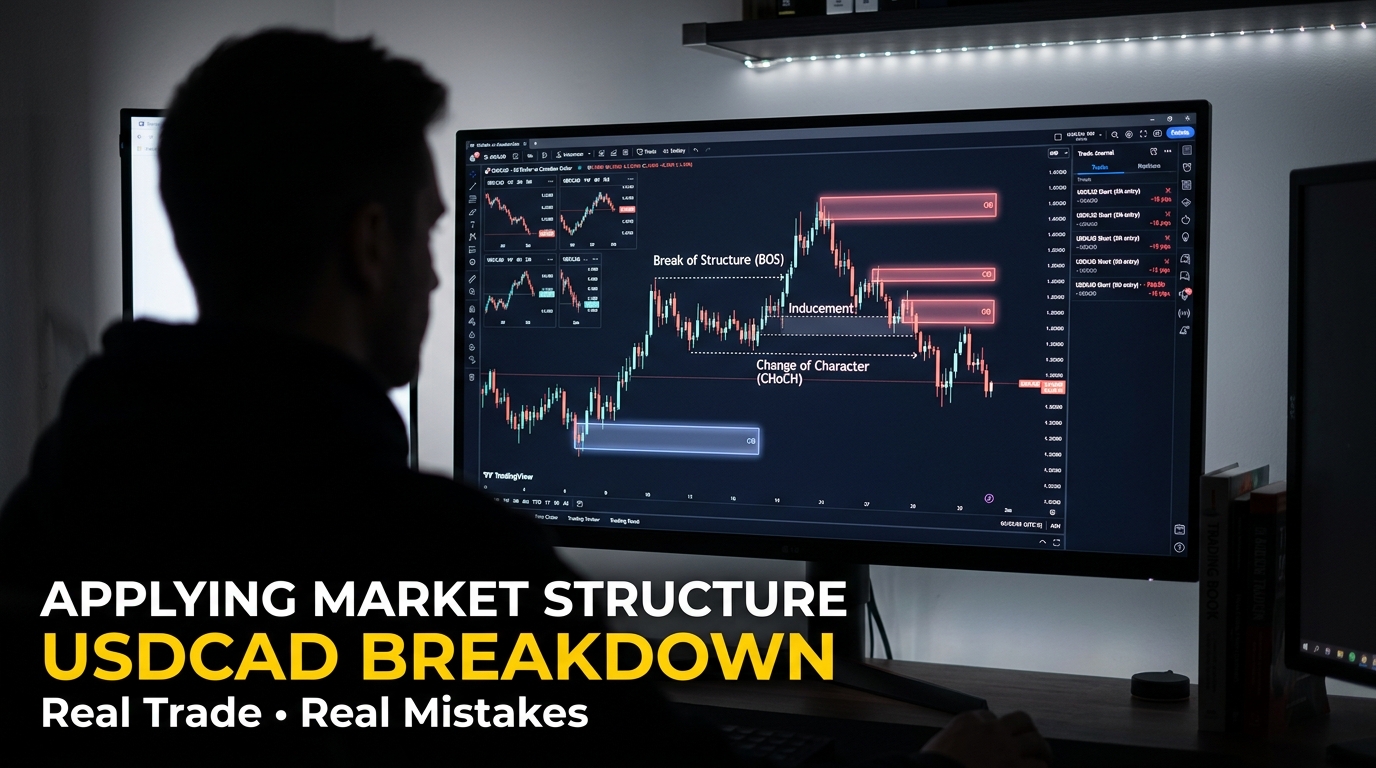
In this diary entry, the focus is on applying Forex market structure analysis to USDCAD for the first time in a practical way. The process is not presented as perfect or complete, but as a learning experience built through repetition, observation, and correction. By explaining each step out loud, mistakes become clearer, and the understanding of Forex market structure improves through that process.
TL;DR
This is a practical walkthrough of applying Forex market structure analysis on USDCAD across multiple timeframes. The process involves identifying inducement, break of structure, and change of character, while refining execution through repeated review. The result includes both insights and mistakes, showing how learning develops through real application.
Understanding the Process of Market Structure Analysis
The approach begins with the intention of applying Forex market structure analysis in a structured way rather than rushing through charts. Explaining the process forces clarity, which helps reduce hasty decisions that might happen when analyzing alone.
Repeating the same analysis multiple times reveals mistakes in implementation. This repetition becomes part of the learning process. It highlights that understanding market structure analysis is not just about identifying patterns but about correctly applying them.
Starting from Higher Timeframes
The analysis starts from the six-month timeframe on USDCAD. At this level, the focus is on identifying a valid pullback to determine whether a move qualifies as a break of structure or if the inducement level needs adjustment.
Since no valid pullback is found on this timeframe, the analysis moves to the three-month chart. This shift shows that applying Forex market structure analysis requires flexibility and adaptation when the structure is not clear.
On the three-month timeframe, an inducement is identified and later hit, defining the high of the range. When this high is broken, it confirms a break of structure, and the low of the range is established. From there, the process continues by tracking how inducement levels evolve as new highs form.
Change of Character and Structure Shifts
As the analysis continues, the low of the range is broken, marking a change of character. This signals a shift from a bullish to a bearish structure. The high remains protected while a new low is defined through inducement.
This step is central to how to apply Forex market structure anlysis because it shows how structure is not static. Each break and reaction updates the overall view, requiring constant reassessment.
Identifying POIs (Poins Of Interest)
After defining structure, the focus shifts to identifying points of interest. These include order blocks and order flow, but only after inducement has been hit.
Areas before inducment or break of structure events are not considered relevant. This helps narrow down the analysis and avoid unnecessary noise. Some order blocks are identified but not respected by price, which shows that not all identified zones will lead to reactions.
This part reflects the practical side of a Market Structure Trading Strategy, where identification alone is not enough and outcomes must be observed.
Top-Down but Dynamic Analysis
The process continues across weekly and four-hour timeframes. A reaction from a higher timeframe influences the interpretation of lower timeframes. What appears as a change of character on one timeframe may align differently with another.
This shows that applying Forex market structure analysis is not strictly top-down but dynamic. The structure evolves as new information appears, requiring adjustments rather than fixed conclusions.
On the four-hour chart, the structure becomes more complex, moving between bullish and bearish phases. Identifying inducement, highs, and lows becomes more detailed, and mistakes in marking these levels become more visible during explanation.
Execution and Trade Outcome
The final step involves moving down to the lower timeframe, specifically the five-minute chart, where a trade is executed. The expectation is based on the broader structure suggesting a downward move.
However, the price does not react as expected. Instead of aligning with the higher timeframe direction or reacting from the identified order block, the trade results in a loss.
This outcome highlights an important part of market structure analysis. Even when the structure appears aligned, execution can still be incorrect. Mistakes in taking the trade are acknowledged, reinforcing the importance of reviewing both analysis and execution.
Learning Through Application
The entire process reflects how applying Forex market structure analysis is closely tied to continuous learning. The act of explaining reveals inconsistencies and forces a more disciplined approach.
It also shows that following a Market Structure Trading Strategy requires more than understanding concepts. It requires repeated practice, correction, and patience.
FAQ
Why is repetition important when learning Forex market structure?
Repetition helps reveal mistakes in implementation. By reviewing the same analysis multiple times, inconsistencies become clearer and understanding improves.
What is the role of inducement in market structure analysis?
Inducement helps define key highs and lows in the structure. It is used to confirm whether a level is valid and how the structure evolves.
Why move between different timeframes?
Different timeframes provide context. When a structure is unclear on one timeframe, moving to another can help identify valid levels and reactions.
What happens when a trade does not follow the expected structure?
It shows that analysis or execution may be incorrect. Reviewing the trade helps identify mistakes and improve future decisions. Still, Forex is a game of probabilities, when one opens a position, this means the theory is depending on one scenario. Other scenarios are prbable, and might happen, causing a loss.
Is market structure analysis always top-down?
No, it can be dynamic. While higher timeframes provide direction, lower timeframes may require adjustments based on new developments. A lower time frame refines finding on higher one, while higher timeframes provide wider perspective and context, but they can also modify a refined POI (point of interest)
Conclusion
Applying Forex market structure analysis to USDCAD in this case highlights the importance of process over outcome. The analysis moves across timeframes, identifies key structural elements, and attempts execution based on that understanding.
The result is not a perfect trade but a clearer view of how the process works. Mistakes become part of the learning, and each step contributes to refining how to apply Forex market structure anlysis in future scenarios.

The Investor
Thursday 23 April 2026
About The Author
I started to look into individual stocks in January 2022. I created this diary initially for myself to track my investing progress, and second, as a place where I can share my ideas publicly, not only on stock investment, but on any venture that I start learning, such as Forex Trading, Blogging, or any other future venture that I might think of trying out.
By repeating things to myself, I learn by trying to explain them to others; therefore, I help myself better understand what I am learning. Additionally, hoping that others will share their ideas and learn from each other, and lastly as an online business where some links that I share are affiliate links, and if anybody bought anything by clicking those links, I will get a commission based on that successful sale, which of course will not affect the price at which you are buying the product or service.
For more detailed information on my affiliate disclosure, please refer to the Full Affiliate Disclosure page.
This blog is also part of my blogging learning project. I’m using a platform to learn this part. If you are interested in it, it is called Wealthy Affiliate.
Furthermore, this site is in no way or form giving any financial or investing advice, nor is it encouraging or discouraging people to buy or sell any financial instrument. This is a personal diary in which I track my own progress and share it for informational, educational, and entertainment purposes.